

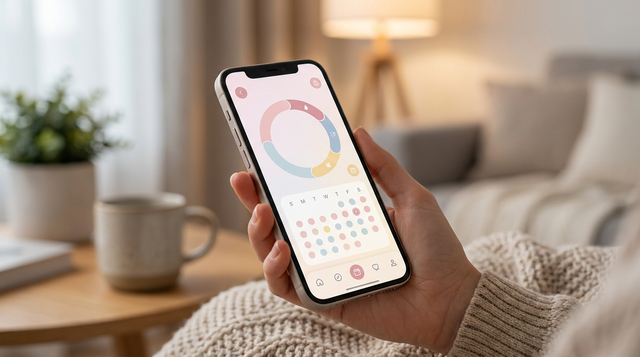
Ever noticed that some weeks you feel magnetic, confident, and genuinely interested in sex — and other weeks you’d rather be left alone with a blanket and a snack? That’s not you being inconsistent or “complicated.” It’s your hormones, moving through their monthly cycle and taking your libido along for the ride. Sexual desire is not meant to be a flat line, and understanding how it ebbs and flows across your cycle can transform how you feel about your body, your relationships, and yourself.
This guide breaks down how desire shifts across the four phases of your cycle, why it happens, what can interfere with it, and how tracking the pattern can help you understand — and honor — your own rhythm of desire.
Desire Isn’t Random — It Has a Rhythm
Your libido is influenced by a cocktail of hormones — estrogen, testosterone, and progesterone chief among them — and because those hormones rise and fall predictably across your cycle, so does your desire, for many women. This isn’t universal (bodies vary, and desire is also deeply psychological and relational), but the hormonal pattern is real and well-recognized.
Understanding it does two things. First, it normalizes the variation — you stop wondering “what’s wrong with me?” when your desire dips, because you understand it’s a phase, not a personality change. Second, it lets you work with your rhythm instead of feeling at its mercy. The hormonal explainers at vyvecare map out how these hormones move, which is the backdrop for understanding your desire.
Libido Across the Four Phases
Menstrual phase (roughly days 1–5)
Desire varies a lot here. Some women feel low libido during their period due to cramps, fatigue, or simply not feeling their best. Others experience a boost — pelvic blood flow, relief from PMS, and lower inhibition can make some women feel more interested, not less. There’s no “right” way to feel; some even find period sex relieves cramps. This is a phase to honor whatever your body is actually saying.
Follicular phase (roughly days 6–13)
As estrogen rises after your period, energy climbs, mood lifts, and libido often starts building. You may feel more confident, more social, and more physically drawn to intimacy as you approach the middle of your cycle. This is the ramp-up.
Ovulation (roughly days 14–16)
For many women, this is the peak. Around ovulation, estrogen peaks and testosterone gets a small boost, and — not coincidentally, from a biological standpoint — desire is often at its highest. This is your body’s fertile window, and evolution has a vested interest in you feeling interested. Many women report feeling their most confident, attractive, and sexually driven around ovulation. If you’ve ever noticed a mid-cycle surge in your interest, this is why.
Luteal phase (roughly days 17–28)
After ovulation, progesterone rises and estrogen dips, and for many women libido gradually declines through the luteal phase — especially in the days before the period, when PMS, fatigue, bloating, and mood changes can dampen desire. Some women do experience a brief uptick right before their period, but the general trend is toward lower desire in the late luteal phase. Knowing this helps you not take it personally — your desire hasn’t vanished, it’s just in its low-tide phase, and it will return.
Why Understanding This Matters for Relationships
One of the most valuable things about understanding your libido’s rhythm is what it does for your relationships and your self-perception. So many women (and their partners) misread a natural dip in desire as a problem — a sign of lost attraction, relationship trouble, or something being “wrong.” Understanding that desire naturally fluctuates with your cycle reframes it entirely: a low-desire week isn’t a red flag, it’s a phase.
This knowledge can take pressure off both partners. It opens up honest conversations (“I’m in my low-libido week, it’s not about you”) and helps couples find rhythm and understanding rather than friction. And it helps you plan and communicate around the times you do feel most connected and interested.
Tracking makes this concrete. When you log your desire alongside your cycle, you can see your personal pattern clearly — and share it, if you choose. The Period Tracker App lets you track mood, energy, and libido alongside your cycle, so your rhythm becomes visible instead of mysterious. Its AI Cycle Coach can help you interpret what you’re noticing, and its adaptive predictions mean you can anticipate your high-desire and low-desire windows.
What Else Affects Your Libido
Hormones set a baseline rhythm, but libido is influenced by many other things — and it’s worth naming them, because desire is never only about your cycle:
- Stress and fatigue— chronically high stress and exhaustion suppress desire for almost everyone. Sometimes a low-libido stretch is more about your life than your cycle.
- Hormonal birth control— some methods can lower libido for some women (and others notice no change or even feel freer). If your desire changed after starting a method, that’s worth noting and discussing.
- Sleep— poor sleep, which often worsens in the late luteal phase anyway, drags down desire.
- Mental and emotional wellbeing— mood, body image, relationship satisfaction, and mental health all shape desire profoundly.
- Life stage— perimenopause, postpartum, and breastfeeding all shift libido, sometimes dramatically.
This is why tracking your libido alongside your mood, sleep, stress, and cycle is so revealing — it helps you tease apart what’s hormonal rhythm and what’s something else you might want to address.
Honoring Your Rhythm
Perhaps the most freeing takeaway is this: there’s nothing wrong with a libido that changes. Desire isn’t supposed to be constant, and a culture that expects women to feel identically interested every day of the month is simply out of step with female physiology.
Working with your rhythm might mean leaning into intimacy and connection during your high-desire ovulation window, and honoring rest, self-connection, and other forms of closeness (which don’t have to be sexual) during your lower-libido luteal days. It might mean communicating your rhythm to a partner so you’re on the same page. And it might mean noticing when a low-libido stretch is longer or deeper than your usual pattern — a cue to look at stress, sleep, contraception, or wellbeing more broadly.
For the emotional and self-connection side of your cycle, some women find reflective practices help them tune into their inner landscape — journaling, meditation, or a contemplative session with an AI companion like Raka Ai, used as a structured way to check in with how they’re feeling about themselves, their bodies, and their relationships. Understanding your desire is, ultimately, part of understanding yourself — and self-knowledge is its own kind of intimacy.
When to Talk to a Doctor
Fluctuating libido across your cycle is normal and healthy. But it’s worth talking to a healthcare provider if you experience a persistent, distressing loss of desire that isn’t just cyclical; if your libido changed markedly after starting a medication or contraceptive and it bothers you; if low desire comes with pain during sex, which always warrants evaluation; or if it’s tied to low mood, relationship distress, or other symptoms you’d like support with. Low desire that troubles you is a valid thing to seek help for, and there are often addressable causes. This article is general information, not medical advice.
Frequently Asked Questions
When is libido highest in the menstrual cycle? For many women, around ovulation (roughly mid-cycle), when estrogen peaks and testosterone gets a small boost. This coincides with the fertile window, and many women report feeling most confident and interested then.
Why does my desire drop before my period? In the late luteal phase, progesterone is higher and estrogen has dropped, and PMS symptoms like fatigue, bloating, and mood changes can dampen desire. It’s a normal low-tide phase, and desire typically returns as your cycle turns over.
Is it normal for my libido to change so much through the month? Completely normal. Desire naturally rises and falls with your hormones. A culture that expects constant desire is out of step with female physiology — variation is the norm, not a problem.
Can tracking my cycle help with my libido? Yes. Logging desire alongside your cycle reveals your personal pattern, so you can anticipate high and low windows, take dips less personally, and communicate your rhythm to a partner. The Period Tracker App makes this easy and adapts to your actual cycle.
Could my birth control be lowering my libido? It’s possible — some hormonal methods lower desire for some women, while others notice no change. If your libido shifted after starting a method and it bothers you, note the pattern and discuss alternatives with your doctor.
Is low libido a sign of a relationship problem? Not necessarily. A natural cyclical dip is physiological, not relational. Understanding this can take pressure off both partners. That said, persistent low desire tied to relationship distress is worth exploring, sometimes with support.
What if my libido is low all the time, not just cyclically? Persistent low desire can stem from stress, sleep, mental health, medications, hormones, or life stage. If it’s distressing, it’s worth talking to a healthcare provider — there are often addressable causes, and you deserve support.
Does stress really kill desire? Yes, for most people. Chronic stress and fatigue suppress libido, sometimes overriding the cyclical pattern entirely. Sometimes a low-desire stretch is your life talking louder than your hormones.
The Bottom Line
Your libido was never meant to be a constant. It rises and falls with the hormonal tide of your cycle — often peaking around ovulation and dipping before your period — and that variation is a feature of healthy female physiology, not a flaw. Understanding your rhythm frees you from the exhausting question of “what’s wrong with me?” and lets you work with your desire: leaning into connection when it’s high, honoring rest when it’s low, and communicating your pattern with confidence.
The way to know your rhythm is to track it. When you can see your desire mapped against your cycle, mood, sleep, and stress, you understand yourself more fully — and you can tell the difference between a normal low-tide week and something worth addressing. Whether you use the AI Cycle Coach in vyvecare or compare options to find the best period tracker for you, the reward is the same: a more understanding, less self-critical, more empowered relationship with your own desire.
This article is general educational information about libido and the menstrual cycle and is not medical advice. If you have concerns about changes in desire, pain during sex, or related symptoms, please consult a qualified healthcare provider.