

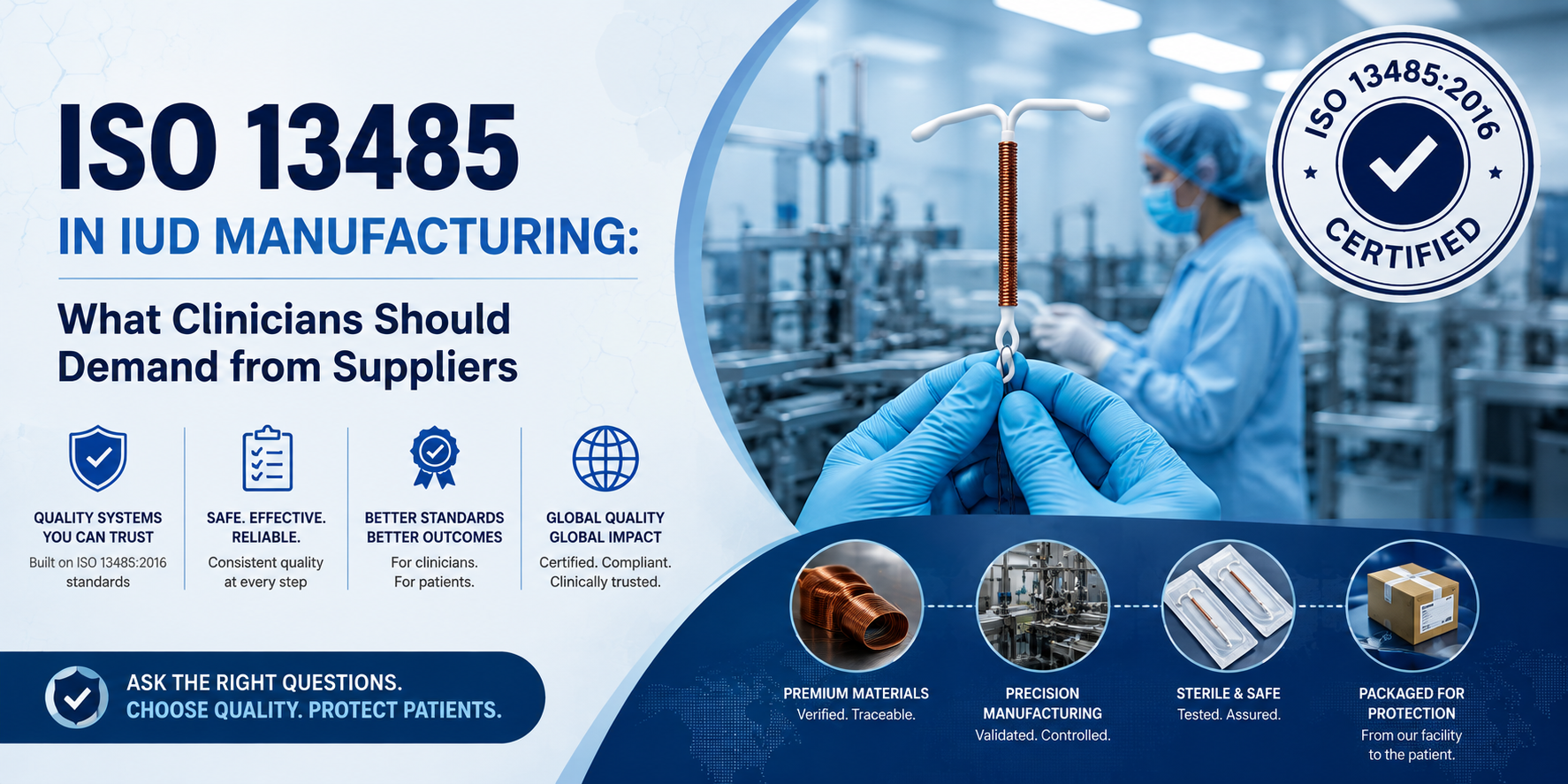
When a clinician inserts a Copper T 380A, they are placing a device that will remain in a patient’s body for up to ten years. That device was manufactured months sometimes years before insertion. The question that rarely gets asked in the clinical setting, but absolutely should be asked in the procurement setting, is: what quality system governed every step of that device’s creation?
ISO 13485:2016 is the answer. It is the international standard for quality management systems in medical device manufacturing and for IUD manufacturers supplying to responsible procurement channels, it is the baseline, not a differentiator. What matters is how deeply it is implemented, and whether clinicians and procurement officers know how to evaluate that.
Why ISO 13485 Matters for IUD Procurement Right Now
The timing of this conversation is not coincidental.
The FDA’s 2026 Regulatory Shift
In February 2024, the FDA finalized a significant regulatory change: by 2026, the US Quality System Regulation (21 CFR Part 820) is formally replaced with ISO 13485:2016 as the baseline for medical device manufacturing compliance in the United States. This aligns America’s domestic device quality requirements with the international standard already mandated across the EU, Canada, Australia, and most WHO procurement frameworks.
For clinicians and procurement professionals sourcing Copper T 380A devices, Silver IUDs, insertion kits, or any contraceptive medical device, this shift means ISO 13485 is no longer a nice-to-have. It is the regulatory floor globally.
Why Not All Certifications Are Equal
A certificate covering a broad portfolio of medical devices tells you far less about IUD manufacturing quality than one with a scope explicitly listing intrauterine contraceptive devices. Knowing how to read the certificate and what questions to ask beyond it is the practical skill this article addresses.
What ISO 13485 Actually Requires from an IUD Manufacturer
ISO 13485 is a quality management system standard, not a product specification. What it mandates is a system that ensures every device produced meets its intended specification, consistently, with documented evidence.
For IUD manufacturers, the critical requirements translate to:
1. Design and Development Control
Every IUD design whether the standard Copper T 380A, a Silver IUD TCu 380Ag, or a custom configuration must have documented design inputs (clinical requirements), design outputs (specifications), verification (does the design meet specs?), and validation (does the device actually perform its intended function?). Without this, a manufacturer cannot demonstrate that their product design is clinically appropriate.
2. Raw Material and Component Traceability
ISO 13485 mandates complete traceability from incoming raw materials to finished device. For copper IUDs, this means the copper wire’s purity certification, the polyethylene compound’s compliance documentation, and the monofilament thread specifications must all be traceable by batch. If a quality issue emerges post-market, the manufacturer must be able to identify which batches are affected and initiate a recall with precision.
3. Production Process Validation
Winding copper wire onto an IUD stem is a manufacturing process. ISO 13485 requires that this process and every other step be validated. This means the manufacturer has demonstrated, with documented evidence, that their process reliably produces a device within specification consistently across production runs. A double-winding system that eliminates wire protrusion must be process-validated to prove it performs consistently not just engineered to do so on paper.
4. Sterility Assurance
Every IUD kit supplied to a clinical setting is a sterile product. ISO 13485 requires that sterilization processes be validated and that sterility assurance levels are documented across the product’s full shelf life. The Mylar-Mylar pouch packaging standard is not arbitrary it is an engineered barrier whose integrity must be validated from manufacture through distribution and storage.
5. Post-Market Surveillance
Manufacturers must have a system to collect and analyze data from the field adverse events, complaints, clinical feedback and feed that data back into their quality management system. A Copper T manufacturer who has completed independent multi-year clinical studies on their specific product is demonstrating this commitment in the most rigorous way possible.
The Content Gap: What Clinicians Are Not Being Told
Most ISO 13485 content is written for manufacturers implementing the standard, not for clinicians evaluating supplier quality. This creates a systematic information gap: procurement decisions are made by people who know that ISO 13485 certification matters but do not know what to probe beyond the certificate number.
Five Questions Every Clinical Procurement Officer Should Ask
Q1: What is the exact scope of your ISO 13485 certificate?
The certificate scope must specifically name intrauterine contraceptive devices. A scope that says “medical devices” or “gynecological instruments” without naming IUDs specifically means the audit scope for your product category may not have been rigorously examined.
Q2: Which notified body issued your CE certificate, and is it still on the EU’s active notified body list?
Some notified bodies have had their designation withdrawn. A CE certificate issued by a no-longer-active notified body is not a current CE marking and a supplier presenting it as valid is presenting outdated credentials.
Q3: Can you provide post-market surveillance data for your specific IUD models?
Independent clinical studies conducted on the manufacturer’s actual product not generic studies on the TCu 380A class demonstrate real-world performance accountability.
Q4: What is your production process validation documentation for copper winding?
This question will immediately distinguish manufacturers with genuine quality systems from those with paper certifications and inconsistent production controls.
Q5: How are your IUD kits validated for sterility through the full shelf life?
Not just at manufacture, but through the distribution chain and storage conditions typical of low-resource settings where temperature and humidity control may be variable.
Silver IUDs and the Complexity of Specialty Product Certification
The Silver IUD TCu 380Ag adds a layer of complexity that tests a manufacturer’s quality system further.
Why Silver Increases the Certification Challenge
Silver is incorporated into the copper-bearing components to reduce fragmentation and provide antimicrobial properties a clinically meaningful differentiation. But it also introduces additional raw material specifications, compatibility considerations, and validation requirements that must be handled as a distinct product line within the quality management system.
What to Verify for Silver IUD Procurement
A manufacturer producing both standard copper IUDs and Silver IUDs under a single ISO 13485 quality management system must demonstrate that the system is robust enough to manage distinct material specifications, distinct validation datasets, and distinct post-market surveillance streams simultaneously. For procurement officers sourcing Silver IUDs for clinical programs, the same supplier questions apply with the additional requirement of verifying how the manufacturer’s QMS specifically handles silver-bearing device formulation and performance data.
Conclusion: Certification Is the Starting Point, Not the End
ISO 13485 certification from a recognized IUD manufacturer is the entry ticket to a serious procurement conversation. It is not the conversation itself. Clinicians and procurement professionals who understand what the standard requires and who know the right questions to ask about its implementation are better positioned to source devices they can stand behind in the clinical setting.
As the FDA’s 2026 alignment with ISO 13485 reshapes quality expectations globally, the bar for supplier accountability is rising. The manufacturers who will continue to earn procurement trust are those who treat ISO 13485 not as a compliance exercise but as an operational framework for clinical accountability.


