

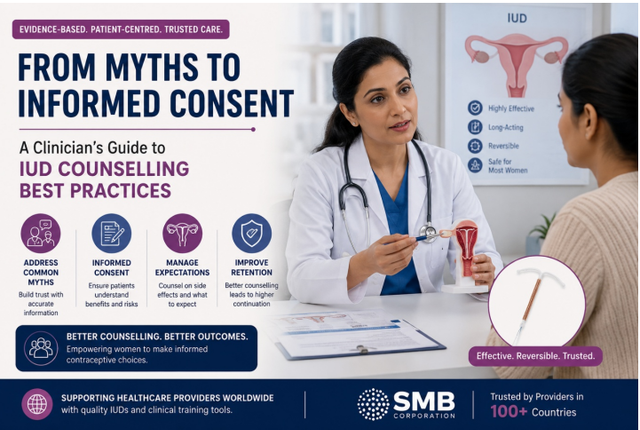
A Clinician’s Guide to IUD Counselling Best Practices
Intrauterine devices (IUDs) are among the most effective, reversible contraceptive methods available today — yet provider counselling remains one of the biggest barriers to uptake. According to WHO data, IUD use could be significantly higher if patients received accurate, comprehensive information at the point of care. The gap between clinical evidence and patient perception is where the counselling conversation happens, and where clinicians have the most power to influence reproductive health outcomes.
This guide is written for gynaecologists, family physicians, and trained nurses who counsel women on contraceptive choices. It outlines structured approaches to informed consent, myth-busting techniques, and strategies to improve IUD acceptance and retention.
Why Counselling Matters More Than the Device Itself
A perfectly inserted IUD will fail its purpose if the patient removes it early due to fear, misinformation, or unmanaged side effect anxiety. Studies across South Asia and Sub-Saharan Africa consistently show that early discontinuation of IUDs — within the first 3–6 months — is driven less by clinical complications and more by inadequate pre-insertion counselling.
Research published in Contraception (2022) found that women who received structured counselling including side effect expectations had a 34% lower early discontinuation rate compared to those who received standard care information only.
The counselling session is therefore not a formality. It is an active clinical intervention that begins before insertion and continues through follow-up.
The Most Common Myths You Will Encounter
Effective counselling starts with understanding what your patient likely already believes. Across clinical settings in India and globally, these are the myths most frequently reported by women considering IUDs:
Myth 1: IUDs Cause Infertility
This is the single most persistent misconception. Women often conflate IUD complications from decades-old devices (particularly the Dalkon Shield of the 1970s) with modern copper and hormonal IUDs. Modern IUDs do not damage the uterus or fallopian tubes. Fertility returns within one to three menstrual cycles after removal for most women.
Clinical approach: Show the patient the device. Explain the mechanism — the copper ions create a sperm-hostile environment and do not alter tubal or ovarian function. Use simple anatomical diagrams where available.
Myth 2: IUDs Are Only for Women Who Have Already Had Children
WHO Medical Eligibility Criteria (MEC) Category 2 guidelines confirm that nulliparous women can safely use IUDs. The FSRH (Faculty of Sexual & Reproductive Healthcare) and American College of Obstetricians and Gynecologists both support IUD use in adolescents and young women who have not had children.
Clinical approach: Acknowledge that insertion may be slightly more uncomfortable in nulliparous women due to cervical os size, but clarify that this is a procedural consideration, not a contraindication. Offer pain management protocols proactively.
Myth 3: IUDs Cause Pelvic Inflammatory Disease
The risk of PID related to IUD use is highest in the 20 days following insertion — and is primarily associated with pre-existing STIs, not the device itself. Routine STI screening before insertion eliminates most of this risk. After the initial period, IUD users have no higher PID risk than non-users.
Clinical approach: Conduct or confirm STI screening before insertion. Document this conversation in the patient record. Explain the 20-day window explicitly so the patient knows what symptoms to watch for and when to return.
Myth 4: The IUD Will Move or Fall Out
Expulsion occurs in 2–10% of users, most commonly in the first year. Teaching patients to check their strings monthly after menstruation is the standard management approach. Spontaneous migration to the abdominal cavity is extremely rare with properly inserted devices.
Clinical approach: Demonstrate string checking during the post-insertion visit. Provide a printed instruction sheet. Confirm thread visibility at the 4–6 week follow-up.
The Structured Counselling Framework: REACH
A structured approach prevents omissions and ensures that every patient receives consistent, evidence-based information. We recommend the REACH framework for IUD counselling sessions:
- R — Review medical history and eligibility (WHO MEC checklist)
- E — Explain the mechanism and what the device looks like
- A — Address myths and patient-specific fears directly
- C — Counsel on expected side effects (bleeding changes, cramping duration)
- H — Hand off with follow-up plan and emergency contact information
Each step should be documented. Informed consent forms should be signed only after all five steps are complete — not at the beginning of the consultation as a formality.
Counselling for Expected Side Effects
Side effect anxiety is one of the primary reasons women decline or discontinue IUDs. Normalising expected changes before they occur dramatically reduces discontinuation.
Copper IUD (Non-Hormonal)
- Menstrual flow may increase by 20–50% in the first 3–6 months
- Cramping during and immediately after menstruation is expected and typically reduces over time
- Spotting between periods may occur in the first few months
- These changes are not signs of failure or damage — they are the normal physiological response
Hormonal IUD (LNG-IUS)
- Irregular spotting is common in the first 3–6 months
- Periods typically become lighter or stop altogether — this is a benefit for many patients, not a concern
- Ovarian cysts may develop but usually resolve without treatment
For both types: Counsel patients that the first three months are an adjustment period. Encourage them to return for reassurance if concerned, rather than self-removing the device.
Special Populations Requiring Tailored Counselling
Adolescents
FSRH and WHO guidelines support IUD use in adolescents. Counselling should include confidentiality assurances, age-appropriate language, and discussion of dual protection (IUDs do not protect against STIs).
Postpartum Women (PPIUCD)
The window immediately after delivery is a high-motivation moment for contraceptive initiation. Postpartum IUD insertion within 48 hours is safe and highly effective. Counselling should ideally occur during the third trimester so the decision is made before the emotional and logistical challenges of the postpartum period.
Women Over 40
Copper IUDs inserted at age 40 or older can remain in place until menopause is confirmed (typically one year of amenorrhoea after age 50). This eliminates the need for repeated contraceptive decisions during the perimenopausal period.
Documentation and Informed Consent
Thorough documentation protects both the patient and the provider. Counselling records should include:
- Date and duration of counselling session
- Topics covered (myths addressed, side effects explained, alternatives discussed)
- Patient’s expressed concerns and how they were addressed
- WHO MEC checklist completed and category confirmed
- Signed informed consent with patient’s own words summarised where possible
- Follow-up appointment scheduled
HConclusion
The IUD counselling session is not a box to tick — it is the most powerful determinant of whether a patient will continue using an effective contraceptive method for years. Clinicians who invest in structured, myth-aware, side-effect-normalising conversations will see higher acceptance rates, lower early discontinuation, and better overall reproductive health outcomes in their practice.
SMB Corporation manufactures a range of copper IUDs and supports healthcare provider training through its IUD Pocket Training Model — a tactile simulation tool used in clinical education programmes across more than 60 countries.